Learning Outcomes
i. Identify the various types of joints in the human body.
ii. Differentiate between movable and immovable joints.
iii. Understand the role of different types of joints in facilitating movement and providing stability.
i. Types of Joints in the Human Body: Joints, also known as articulations, are points where two or more bones meet. They are classified by their structure and the movements they allow.
ii. Movable Joints
Synovial Joints: The most common and movable type of joint, characterized by a fluid-filled joint cavity. Examples include:
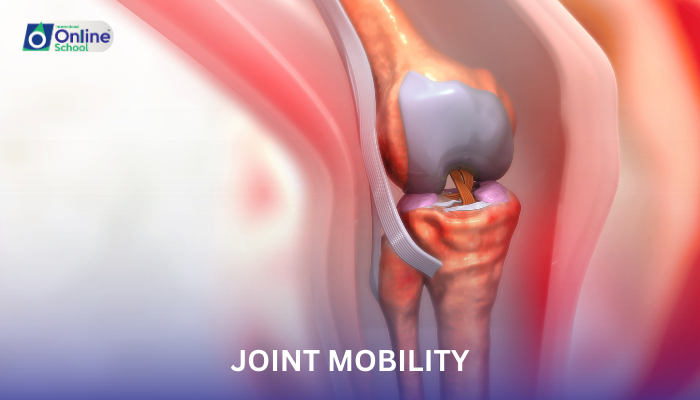
Hinge Joints: Allow for flexion and extension, as seen in the elbows and knees.
Ball-and-Socket Joints: Allow for a greater range of motion, including rotation, as seen in the shoulders and hips.
Pivot Joints: Enable rotational movement, such as the joint between the first and second cervical vertebrae (the atlas and axis).
Saddle Joints: Permit movement along two planes, such as the joint at the base of the thumb.
Gliding Joints: Allow bones to glide past one another in any direction along the plane of the joint, like those found in the wrists and ankles.
iii. Immoveable Joints
Fibrous Joints: Bones are joined directly by fibrous tissue and do not have a joint cavity, making them generally immovable. An example is the sutures of the skull.
iv.Significance in Movement and Stability
Movable Joints: Provide the flexibility necessary for motion while maintaining stability through joint capsules, ligaments, and muscle tendons.
Immovable Joints: Offer protection and stability, as in the case of the skull, where the sutures securely connect the bones to protect the brain.
In conclusion, joints are crucial to the skeletal system, with movable joints enabling the body to perform a wide range of movements and immovable joints providing stability and protection. The structure and function of different types of joints are intricately related to the demands placed on them by the body's movements and the need for stability in certain regions. Understanding the variety and complexity of joints is key to comprehending how the body maintains mobility and stability.
